
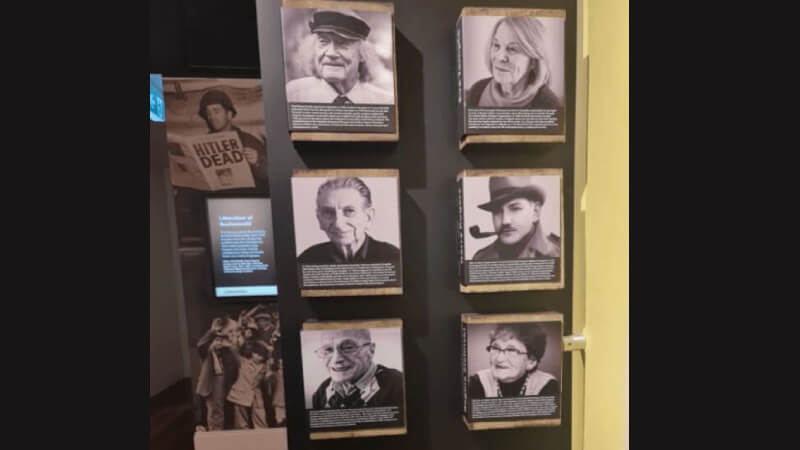
“Memory is what makes us. We need to create a place where people are allowed to cry. We need to unlock the empathy.” — Prof John Carty, during his sharing with Masters of Curatorial and Museum Studies students in the Indigenous section of the South Australia Museum
It was noon on Sunday. I had just attended the 11 am Mass in St Francis Cathedral and decided to hop next door to a museum I’ve always wanted to visit. It was open to the public only on Sundays. As I approached the Adelaide Holocaust Museum, I couldn’t help but feel a sense of irony. Here I was, standing next to one of the city’s most revered places of worship, and yet just a few steps away was a museum dedicated to the memory of one of the darkest periods in human history. The Catholic Church has a complicated history with the Jewish people, and the proximity of the museum to the cathedral felt like a poignant reminder of this history. So I was comforted to discover that the Museum has negotiated a peppercorn lease from the church for Fennescey House, where the museum is located.

Six Auschwitz survivors share their stories
Enter the glass door and go right to enter the education centre which is a dimly-lit room where videos of six Holocaust survivors are looped-screened. It brings to mind a lecture theatre setting, with chairs neatly arranged. I peeked inside and decided that I’d do the exhibition first. As an author, the written word appealed more to me than moving images and sound. I’m glad I did the exhibition first, but for a different reason.
Turn left and you’d be confronted with a walk-through series of panels, hemming you in from both sides. I immediately felt the claustrophobia. Every bit in the living-room-sized space screamed for your attention. From the rise of Nazi Germany to the liberation of the concentration camps, I was immersed in a journey through one of the darkest periods of human history. Through aptly-placed photographs and personal testimonies from Holocaust survivors, through reading the personal accounts of the survivors and seeing photographs of their experiences, I felt a certain sadness, loss and grief overwhelming me. That grief turned into hope as I stepped into the “lecture theatre.” Which is why I would recommend viewing the exhibition at the end of the walk-through to better understand the testimonies which highlight the resilience and strength of the survivors, who were able to rebuild their lives after the trauma of the Holocaust.
A few exhibits touched me to the core. Why the Jews? History’s Oldest Hatred explores the origins and history of anti-Semitism, the prejudice and discrimination against Jewish people. Through a range of artefacts, documents, and personal testimonies, the exhibit traces the roots of anti-Semitism back to ancient times and explores how it has manifested in different societies throughout history. The exhibit highlights the role of propaganda and scapegoating in promoting anti-Semitic beliefs and actions and provides a powerful reminder of the dangers of hatred and intolerance. For me, this exhibit serves as a call to action for visitors to confront and challenge prejudice and discrimination in all its forms.
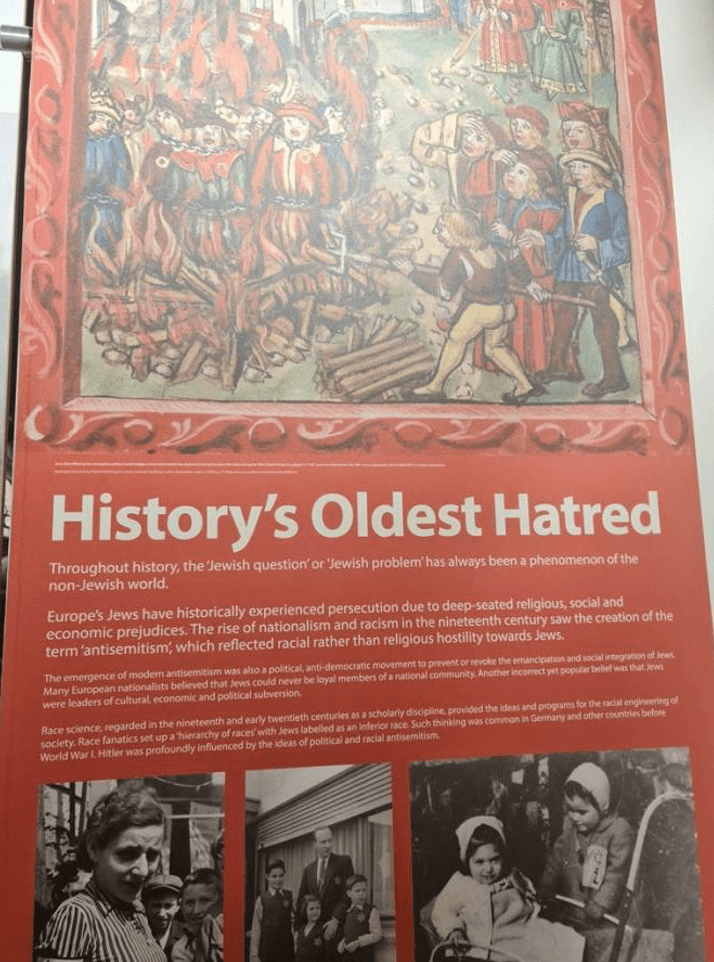
The Origins of anti-Semitism explained
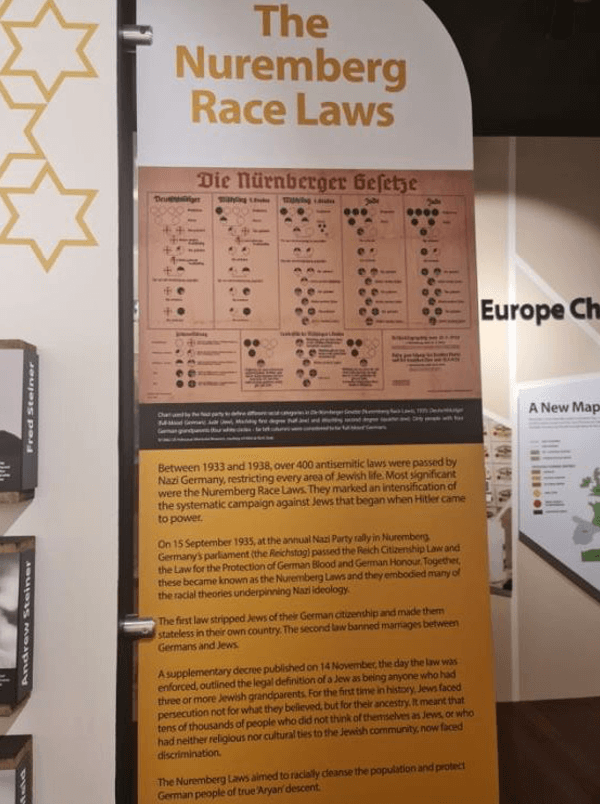
Discrimination at its vilest
Another exhibit that sent shivers down my spine was The Nuremberg Race Laws, a set of discriminatory laws passed by the Nazi Party in Germany in 1935. The laws defined Jews as a separate race and stripped them of their citizenship rights, forbidding them from marrying or having sexual relations with non-Jews. The laws also imposed a range of restrictions on Jews, including banning them from certain professions and public spaces. The Nuremberg Race Laws were the precursor to the Holocaust. The laws serve as a chilling reminder of the dangers of bigotry and discrimination.
But perhaps the most chilling of all, albeit the most riveting and fascinating, is the huge wall called The Auschwitz Album. Could a person stand in front of this wall, read the text and then study the stark black and white photos, from first row to last, and not be affected? Prof John Carty shared about “creating a place where people are allowed to cry.” I stood rooted to the spot. Arrival. Waiting For Selection. Selected for Slave Labour. Doomed to Death. Last Moments before Gas Chamber. Words on its own sounded gruesome. Coupled with the photos, one can only wonder.
Last Moments before Gas Chamber. The photo of the little girl, probably no more than five years old, stared back at me. Time stood still. I felt the stab of tears. Angry tears. Helpless tears. This begs the question: Can the children of today learn from the past? That we may never have to face this horror again?
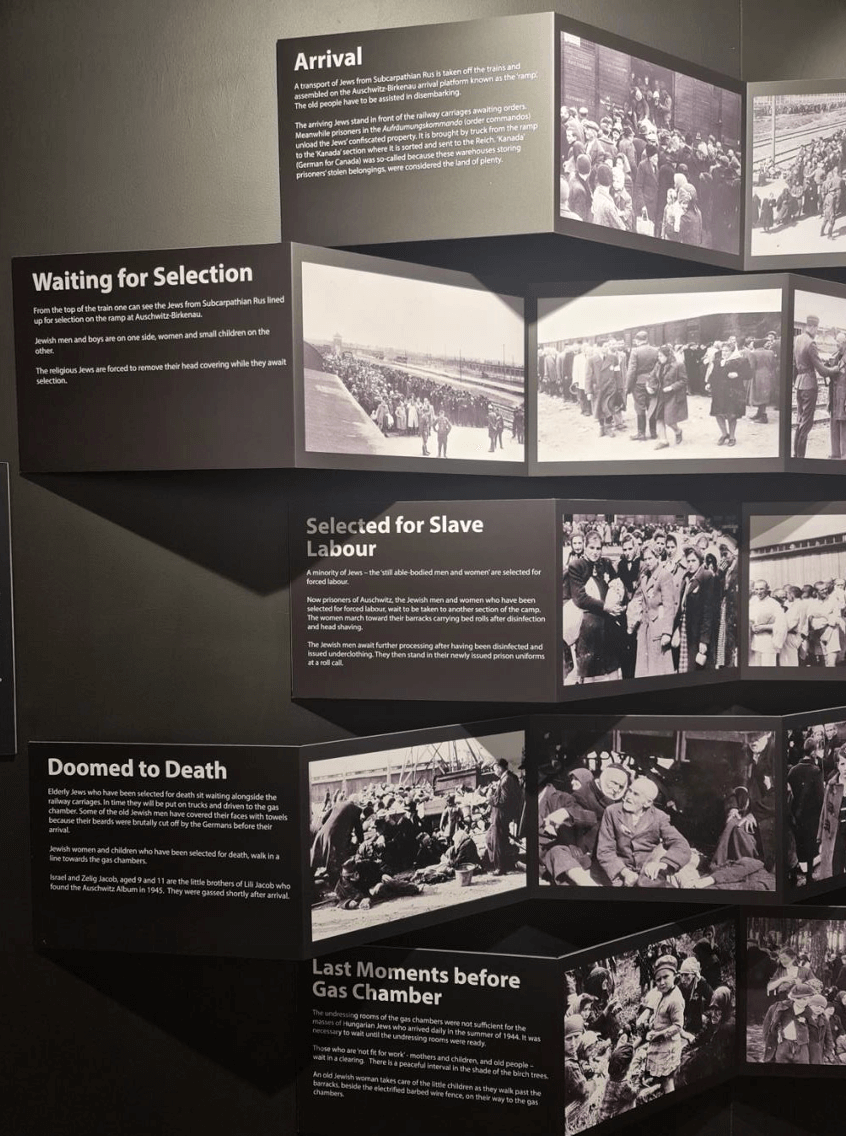
Last moments before the Gas Chamber
Hence the Andrew Steiner Education Centre, housed in the Museum’s precincts. The Centre’s programmes, which are based on the principles of Rudolf Steiner’s philosophy of education, aim to foster resilience, creativity, and empathy in children who have experienced trauma. Through workshops, seminars, and other activities, the Centre provides a safe and nurturing environment for children to heal and grow. The Centre has a particular focus on the use of the arts, such as music, drama, and storytelling, as a tool for healing and transformation.
According to Mr Tamas Lorinz, the museum’s education co-ordinator, “it was a curatorial decision to organize the exhibits into the six themes which visitors will walk through.” Why? To make it more accessible to students to explore. Which was why, as I weaved through the exhibition, I felt like I was walking through the pages of a magazine. Tamas added, “The poster boards that define each of the themes are also layout as in a magazine page. There’s the headline, the key information in bigger font, then more details in smaller font.”
As I stepped out into the warm sunshine after two hours, I wondered. I wondered about the purpose of museums. About the purpose of memory. And I thank God for the Adelaide Holocaust Museum. Where we see mankind at its worst, and also its best.

