

Fifty-four years ago, a 10-year-old opened a box containing 20 books in the Time Life History collection. It costs $200, which was half of her father’s monthly salary. But he had bought it for her because it was the first time he had bought her a birthday present.
The 10-year-old was ecstatic. As she took out each hardcover volume, she mouthed each title aloud. Ancient China. Ancient India. Medieval Europe. Classical Greece. The Roman Empire. Ancient Egypt. She flipped through each page. Her eyes just savoured each word. Each coloured picture. That night, she forgot to take her dinner.
At 13, she had her first short story published in her country’s top newspaper. At 18, she sat for her A Levels and scored a B+ for Ancient History. She intended to take up History or Literature in university. But no, her father, the sole breadwinner, had retired and being the eldest in the family, she had to start working to support her younger sister who had enrolled into a secretarial course.
The year was 1978. That 18-year-old girl was me. I did not pursue that dream. I got married at 24, had three girls by 31, then entered an editorial position and worked my way up from there. At 36, I became editor-in-chief of an international magazine, published by PHP mInstitute, a Japanese thinktank founded by Konosuke Matsushita. Spent close to 30 years in media and publishing.
I call myself a literary traveller. A historical literary traveller might be more accurate. And while exploring a series of historical children’s fiction where three children travel back in time to encounter children their age, and solve mysteries, I decided, hey, why not enrol in the Masters of Curatorial and Museum Studies?
Never did I imagine I would secure an internship in the Classics Museum. And work with Margaret O’Hea, the director of the Museum itself! I needed to learn as much as I can. But how to, when it’s only a 12-week internship? Fear not, I told myself, if God has led me this far, He will surely find a way for me!
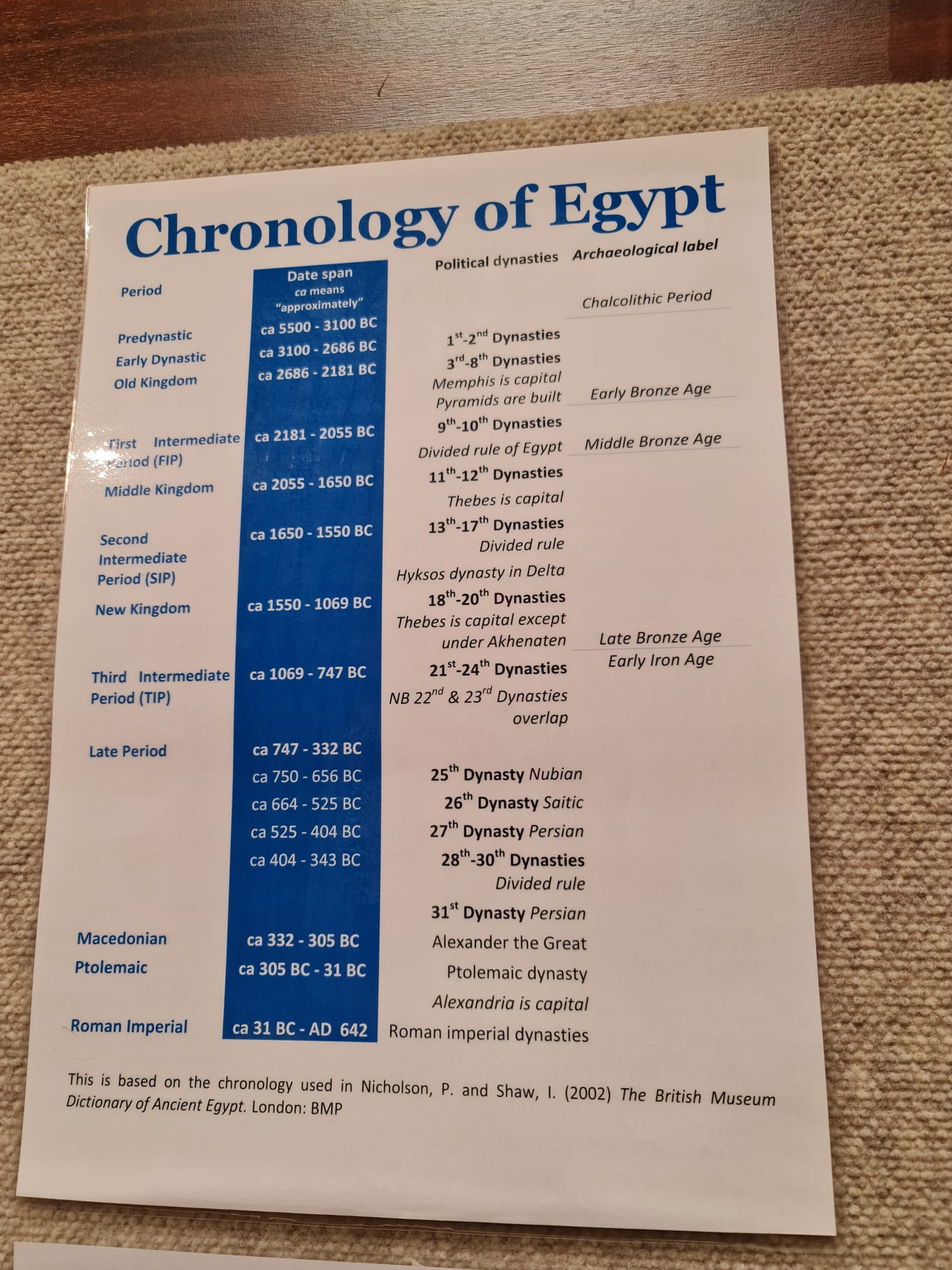
Chronology of Egypt

Detached mummys hand and canopic jar lid
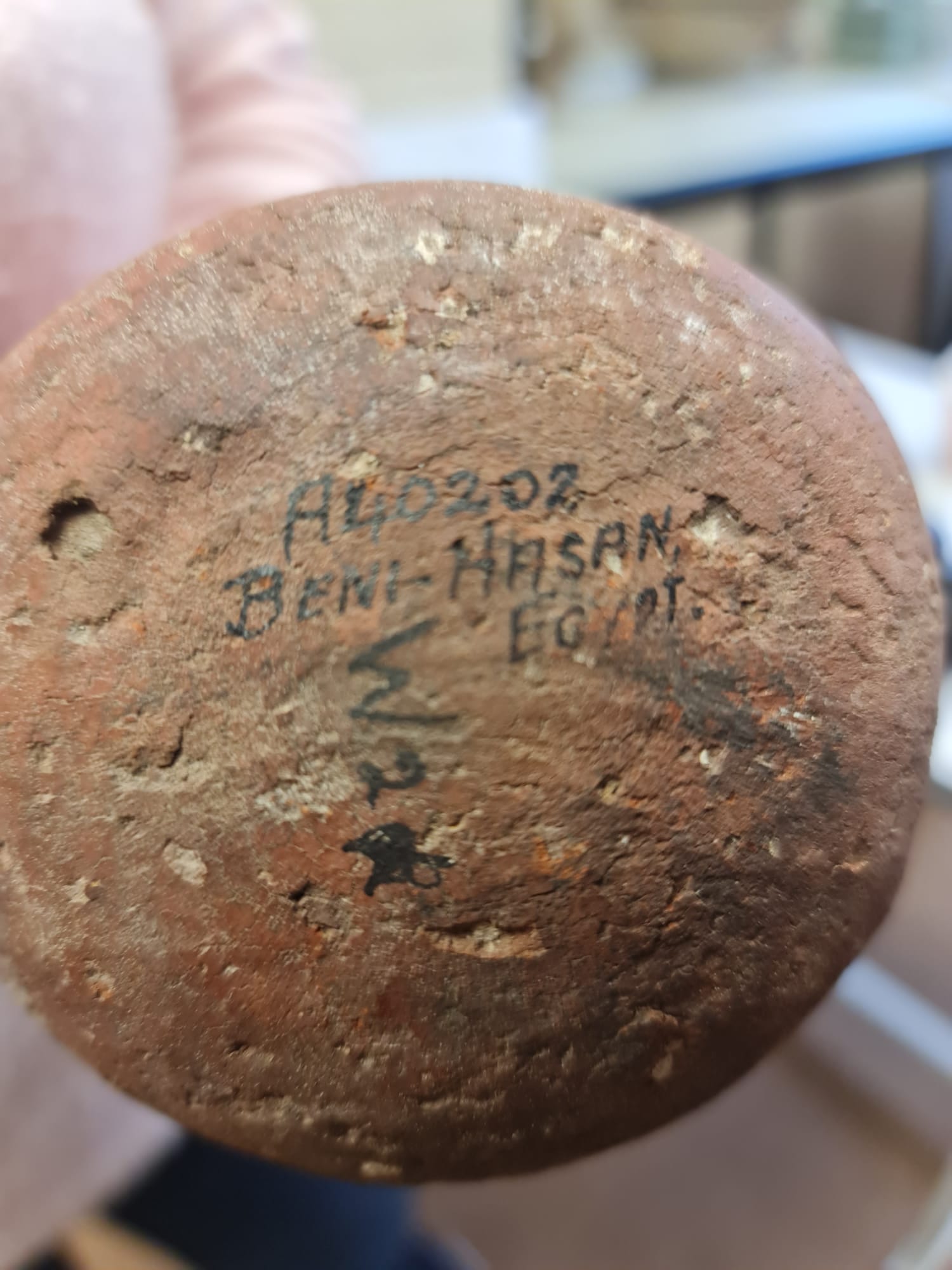
Excavated in Beni Hasan
I was immensely awed and so afraid of accidentally breaking any artefacts during my first week. The Egyptian finds from the Beni Hasan site are 4,000 years old, Margaret told me on the first day of my internship. We had discussed last semester that my internship project would be to curate a digital flipbook of selected artefacts with their stories.
She had gotten hold of a new software, Polycam, which will render in 3D any object which it photographs. What we had to do was photograph the object at many angles, and allow the software to work its magic. What will come out is a video of the object from different angles. She even brought in a turntable to do this. She had an IPhone, which the Lidar software worked with and it came out amazing! But mine was an Android and though I followed instructions, my video came out like the object had melted! Never mind that, she told me. Practise more. I did, at home, under the curious eyes of Casper and Tubby, my daughter’s two cats! The trick is to take more than 40 photographs so the software can sew all of them together. But it was taking too much time, so she decided for me to help her with another task.
Margaret had decided to re-photograph the artefacts as the last time she did it was more than a decade ago. We focussed on the Egyptian cabinet. “Pottery from the ordinary people’s tombs, which are in front of the royal’s tombs,” Margaret pointed out. So many facts I’ve learnt! Here’s a few:


An object from many angles
1/ All the pottery were found in the tombs. They were made from clay from the River Nile and were probably hastily made. They would have contained food or spices (salt and pepper) to see the dead through their journey to the afterlife.
2/ I asked Margaret if I had to wear gloves to handle the artefacts. Nope, not for pottery. For coins, yes. But she mentioned that Incralac was sprayed on the coins she had, to protect them so it was alright to handle them without gloves.
3/ For artefacts, there is the objective and the subjective. Objectives can be seen and are not to be debated, whereas Subjectives are open to interpretation.
4/ How does one know the size of the artefact? Take the photo with 5- or 10-cm ceramic scales (and oh yes, one must also have Blu Tac handy to keep the scales upright!)
5/ Cataloguing is done via Microsoft Access, a painstaking process, I found out. Margaret created the catalogue, took and developed the photographs (then it had to be printed, so she had her own dark room), and then assembled it on the database.
So yes, I’ve learnt after two weeks in my internship, how to handle artefacts properly I’m excited as to what else I’m going to discover. I am also looking forward to interviewing Margaret on the artefacts I’m going to include in the flipbook.
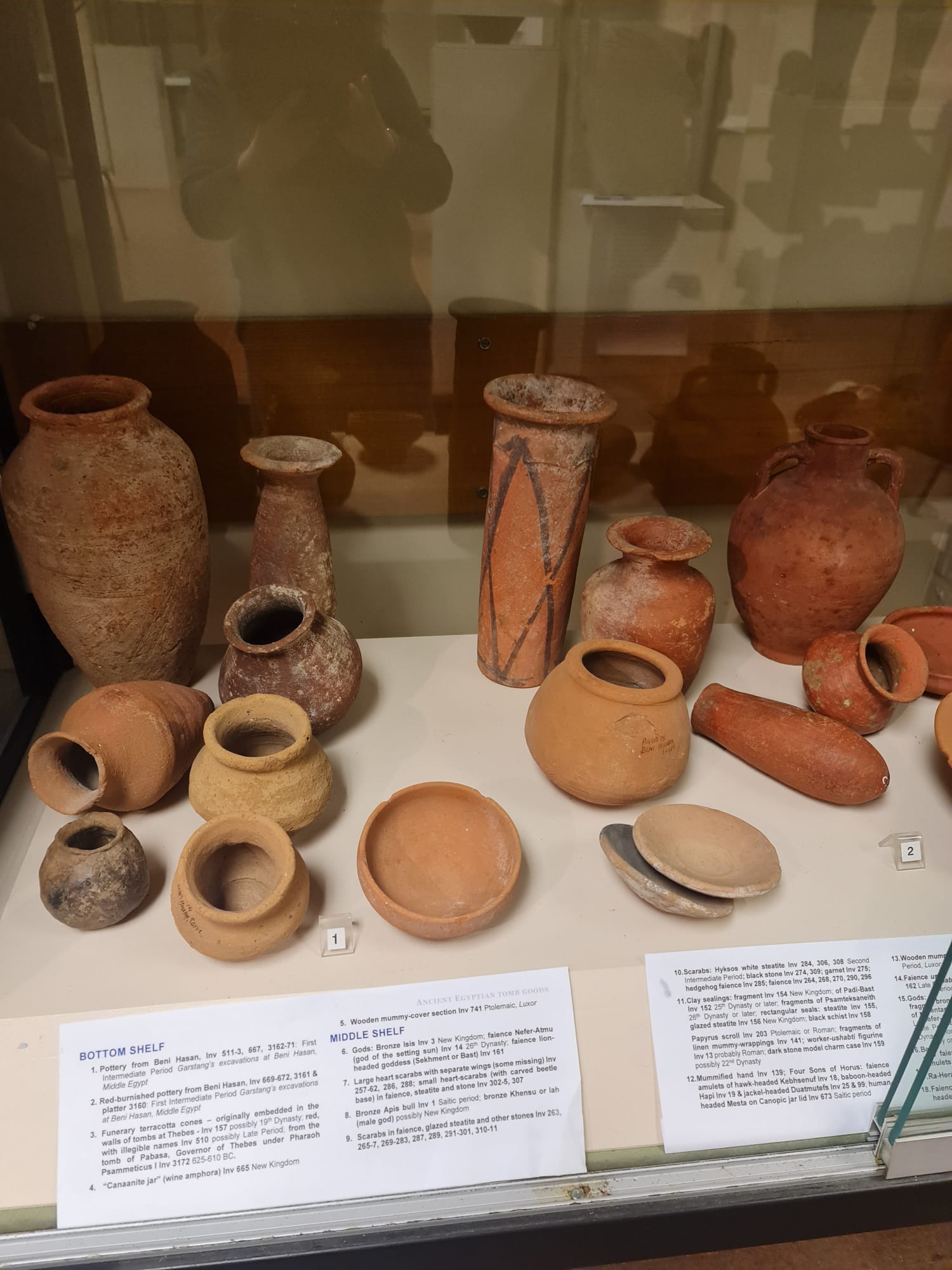
Pottery from the New Kingdom close to 4,000 years old

Where the Egyptian objects were found

